Friday, 30 December 2016

Evaluation Q7


7. Looking back at your preliminary task, what do you feel you have learnt in the progression from it to the full product? by Dom Lewis


Script for Q7:

7. Looking back at your preliminary task, what do you feel you have learnt in the progression from it to the full product?


From the beginning of the task, I have learnt many things leading to creating a much better main brief than from my mini brief. Looking back at my preliminary task I saw my weaknesses of; shots with dead space, rule of thirds was not applied to my shots, unsteady shots, out of focus shots due to not being able to use camera and tripod properly and lastly poor mise-en-scene.

To improve the weaknesses shown in my mini brief, I ensured that I practised and learnt more about how to improve these negatives to make sure it did not occur again in the main brief.


Firstly, correcting unsteady shots. The way I improved this problem was by firstly making sure I booked out the tripod in advance when planning to film. This meant I had a tripod to assist getting steadier shots. However, I did all of this in my mini brief. But where the difference was made this time was learning how to position a tripod properly as well as setting up and fixing the camera onto the tripod correctly. The effect this had on my main brief was that it gave it a more professional look by better filmed shots.

Moving on, when thinking about mise-en-scene, we ensured that it suited the genre of our opening as well as being personalised to our narrative. The way I used research to help gather this information was through questionnaires and research into similar products such as in the film The Woman In Black. This showed us that a location such as an elevator can help isolate the victim creating more suspense. Also, that the costume choice of all black for the antagonist connotes death and danger. We also made sure there was no relevant props in the background to be spotted to maintain a professional look.

The dead space that was in my mini brief was easily overcome in my main brief by a simple touch. This was the grid button on the camera. This grid showed me where each actor was in the shot as well as the background and other props. This eliminated dead space as I could place what I wanted where due to also being my role as the director. This was done using the rule of thirds, so that I made sure the protagonist and antagonist were the main focus, drawing attention to them.

Furthermore, the skill of using the camera correctly to keep shots in focus was vital. I learnt and practised using the camera to film in focus shots unlike my mini brief. There is a button on the camera which gets the shot in focus which was very important as didn't know about it when filming my mini brief.

Also, planning for my main brief was something I did much better than my mini brief. This is because when we got to filming I already new which shots roughly I needed. Also, I had the 180 degree rule in mind at all time so that the audience was never confused.


Moreover, sound is a micro-element vital to any piece. I learnt this from our mini brief. The only sounds in our mini brief was speech which is not captured very well on the camera and the level varies. So when we took on the main brief research into similar products became essential in ideas and ways of using successful sounds to create a particular feeling for the audience.This gave us inspiration to find and create an excellent soundtrack of six different layers of sounds the whole way through the piece to intertwine creating the tension to the piece.


Then after correcting all these mistakes shown in my mini brief now better in my main brief, my editing skills have got massively better just through sheer practise and time spent on the editing software. My editing skills also advanced through the editing tutorials provided by WeVideo which gave basic instructions of how to do simple stuff on the software. Once my editing skills advanced it was a lot easier merging and improving my main brief videos compared to my mini brief. I watched other tutorials on text and credits, meaning I was able to create effective credits on our main brief remove the amateurism of our video.


I then looked how to achieve a level four. Then I found out that I needed material that related to the target audience of our final product. So I took action by carrying out more research on the stereotypical horror target audience. I then took out primary research by creating questionnaires which was shared on social media, which gave me another insight.The information I gathered from this was to definitely be shown in my main brief. The credits I used in my opening was to be defined by my target audience research and what is similar to the films that are similar to my own.


For time management, this was 100 times better for our main brief than our mini brief. This is because we gave ourselves plenty of time to re-shot when needed, which before we didn't at all as we left our mini brief to the dying moments. The reason we made this error was because we did not create a production schedule, however for the main brief, it was one of our first steps. Our production schedule included: research into similar products, research into micro-elements, research into filming, when to film, when to re film, how to edit, when to edit. This was all spread out all in proportion to the activities so that it gave enough time to complete everything with time to re-do if needed. This allowed us to get most of the pre-production work done very early to allow us as much time in post-production as in theory is the most important stage as it's the 'finishing touch'.

Thursday, 15 December 2016

Evaluation Q6

Q6. What have you learnt about technologies from the process of constructing this product?


Script for Q6

Planning & Research:


BLOGGER


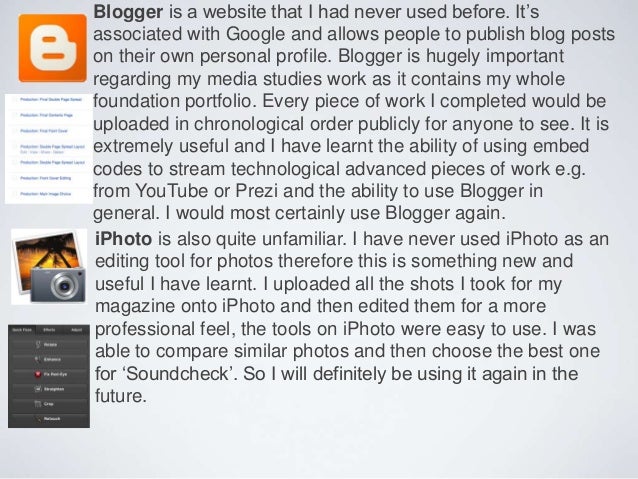
Blogger is a website that I had never used before. It’s associated with Google and allows people to publish blog posts on their own personal profile. This is where I have been able to upload all my findings, evidence and progress of the planning, filming and editing and evaluation of the media product that I have created .Blogger is hugely important regarding my media studies work as it contains my whole foundation portfolio. Every piece of work I completed would be uploaded in chronological order publicly for anyone to see. It is extremely useful and I have learnt the ability of using embed codes to stream technological advanced pieces of work e.g.from YouTube or Prezi and the ability to use Blogger in general.I previously have never used blogger before but I have learnt that it is another simplistic way to contact and communicate with others from around the globe. Other websites such as Facebook, Twitter, Tumblr and YouTube are connected to blogger and made it very easy to make my blog interactive so I was able to include images and videos of my progress. Completing my work online has also shown me how the technology and media convergence is growing. I have really benefited from using this website as it is easily accessible, self-explanatory and easy to use, I would most certainly use Blogger again.


GOOGLE DRIVE

I used Google Drive to receive all my lesson information to help me with my research and work. Then I stored all my research, photos and videos that I could possibly use in my work on Blogger or on my main brief. Google Drive was an excellent storage site due to having the ability to also share all this information at the same time with the colleagues in my group. This made it a lot easier to complete work and share ideas, allowing us all to edit at the same time. Google also offers to create questionnaires through Google Forms, a unique and easy way to create forms of any sort. This was useful as allowed me to create questionnaires quickly to then be able send them via email to anyone I wanted or to published on social media, giving us a large variety of responses back relatively fast. Furthermore, I also used Google Slides, another aspect Google offers. I used Google Slides to produce a pitch for our main brief Blackout with with my team. Both these extras allowed me to gain a better picture of my main brief and a better main target audience.


YouTube & Netflix

Netflix and YouTube was a vital source of research. I used these sources to mainly watch the opening scenes of horror films. However I also used them to watch other genres to look at credits and opening layouts, as well as tutorial videos and sound sources from YouTube. The problems I faced with this is that they didn't always have the films I would of liked to analyse. However, this was easily adaptable due to the millions of films to be an alternative. So for these textual analysis I spotted the codes and conventions and the micro elements they conveyed. I then posted some of the textual analysis' on blogger; The Woman In Black, Scream and Blade.


Filming:


CAMERA

The camera I used to film both my mini brief and main brief was the Canon DLSR. For experience, I have used this camera before for my year 11 GCSE Media studies work. However, I still faced the same problems which were; the manual focus and manual zoom. Despite having these problems they were not hard to overcome and in some ways helped with filming. This is because it made us think and double check our shots which resulted in some very intriguing and different shots, mostly in great quality. Due to filming in an elevator, there were many dark and shadowed spaces, but the camera was great as it managed to still catch high quality shots.


Editing:


WE VIDEO

We Video was the software I used to edit my footage. I have never used We Video to edit before, however I have used similar software such as imovie and Adobe Premium. These software's showed similar qualities therefore I could transfer my knowledge, allowing me to have a head start in knowing how to edit. The storyboard mode was even easier which made it more simple to edit clips, adding effects, animations and sounds. I also learnt that you can share the media project to my whole group, then allowing us to all edit separately but using the same media. It was also better than the other softwares I have previously used because I could access the editing software at home or anywhere, just as long as I had a compatible device with Google Chrome, making it a lot easier to work on the main brief.


YOUTUBE
We had to upload a large proportion of our final work to YouTube. From this we had to embed a code to be able to convert and post on our blogs. This made it quick and simple to transfer material. Also, YouTube provided a large variety of sound effects. This was also useful as had button to convert to mp3 making it easy to upload on our main brief and evaluation questions. I learnt that YouTube is very useful and will certainly be using it again and it did not phase me any problems.


ADOBE PHOTOSHOP


Adobe photoshop was a post filming software I used on my own for our main brief. I was familiar and used to this software because I used it throughout year 10 & 11 media, therefore this editing stage did not cause me any problems. With a lot work put into the main brief I was able to finalise editing a video clip for our brief. This was to make the eyes of our antagonist completely black, for our horror effect. I also used it to remove backgrounds for our main brief credits. Photoshop will definitely be used again as i'm experienced in the software and generates great results when used properly.


FONTSPACE

Fontspace was a website that had many pre-generated font styles that are free to download. No problems were faced. It was easy and quick to find different fonts. I just spent time looking for a particular font I wanted so that it suited our main brief. After saving the image, all I did was use photoshop to remove the background leaving just the credits to then use in my main brief.

Tuesday, 6 December 2016

Evaluation Q4 & Q5


Q4. Who would be the audience for your media product?

Q5. How did you attract/address your audience?


Script for Q4&5

Host: Hello and welcome back to the ASM show. Today I'm here with Thabo, Joe, Dom, and Nimat to talk about their main brief; Blackout.

(APPLAUSE)

BO: Thanks for having us.

Host: So, who would be the audience for your media product?

BO:  Our main target audience is aged 15 and over as a certification of 15 allows a larger proportion of teenager to watch the film. We didn't make it a 12 as our media product doesn't fit with the guidelines of the BBFC requirements, and we didn't want to make adjustments to our product as it would have lost its scare factor. Also, we didn't certify the product as an 18 as we would lose half of our target audience.

Host: How did you come to that conclusion?

BO: Well, our product is filmed and edited to suit a demographic of C1-E, which includes skilled manual workers and the unemployed. As our target audience lies within these demographics, if its certification was any higher, not many people would like to view our product, which will narrow our viewing audience and reduce our profit.
Host: And how about your psychographic?

We looked at the psychographic of our desired target audience to see if their traits were compatible with the generic codes and conventions of the paranormal subgenre of horror. Sticking to these codes conforms to the audience's expectations. The younger demographic are stereotypically more likely to take risks and go to see an explicit media product, in comparison to the older demographic who are seen to watch more conservative products. The younger demographic's interpretation of what our media product presents is creative.

Host: What makes your audience want to watch horror films?

BO: Well, according to the uses and gratifications theory by Katz, the audience want to watch horror films as this is their option of relaxing in their free time. This is how they use the media. They then gratify the media in such ways such as escapism. They seek to escape from their reality, so they watch these films in order to feel better about life and think 'at least I'm not being possessed or someone's trying to kill me', or just to take their mind of reality completely.
For instance, our demographic target audience of teenagers would most likely want to escape from exam stress.

Host: Did you research into other similar products?

BO: Yes. We started by researching into similar products of the same paranormal subgenre that were proven quite successful in the box office. Films you may know like The Babadook, The Conjuring, The Blair Witch Project, The Grudge, The Ring, Insidious, Psycho, The Omen, the list goes on! They all have the certification of 15. And from this we decided to investigate and create a questionnaire for ages of 15 and over (because the typical certification for a horror is either a 15 or an 18).

Host: Now why don't you tell our viewers about that.

Y: Well, the results from the questionnaire showed the majority of participants to be 16, proving that they are constantly on social media (as we broadcasted our questionnaire via social media sites and apps), so this age group would always be fed our advertisement for our main brief online. They'd eventually share the advertisement and pass it onto their friends, giving our product a larger audience.

Z: Although comedy was voted the most favourite horror subgenre, we decided not to produce a mock horror as we would like to stick to the generic conventions of horror. It was interesting to see that the paranormal and psychological subgenres were the second and third most favourite ones to watch. That gave us hope for a main brief. The questionnaire also revealed to us that not many people of the younger generation favoured the slasher subgenre as they are immune to the fear it presents, so completely scrapped our first idea of a slasher in the shadows.


A: Most of the people who participated in the questionnaire are 15-17, which explains why the dominant price was £5-£10 - people of this age don't have extravagant amounts of money to spend so they look for cheap pleasure and entertainment. But appealing and earning a profit from thousands of teens is better than a few extravagant profits from a small selection of adults.


Host: So, how did you attract and address your audience?

BO: We worked with companies such as Lionsgate Entertainment and Ghost House Pictures who already have a large following of viewers interested in the horror genre. They have an establishment with our target audience as they have had previous success within the horror industry. We went out and showed members of our audience clips of our main brief and our narrative structure to see if they were interested and what they had to say. From there, they passed it on to their friends and so, getting across to more people, increasing the awareness of Blackout.

Host: Now I heard you presented some sort of pitch..?

BO: Yes, we had to present it to some of our investors. Our pitch was based on our questionnaire actually. It played a really big role in our target audience research as we gained some feedback from our investors. Someone asked "Do you think you'll be cutting out the female audience?". To this we answered that the male is our main audience, so there will be events within our product that will not appeal to the female audience and they will be excluded from the storyline. Males are more likely to be fans of horror than females are. This is due to the stereotypical thrill seeker, portrayed by the male. Violence is a convention of the horror genre, and is loved by males as they use violence to be dominant and prove their status. Although this is the case, our secondary audience is female, so we will make sure that the footage we shoot keeps them involved for the majority of the opening.

Host: After all the research you've clearly put in, how have you then applied this to your media product to produce this scare factor?

BO: The way we've used this research effectively is by presenting the micro elements in our media product. The micro elements are sound, mise en scene, editing, and camera angles, we have used a dynamic non-diegetic soundtrack, as well as costume such as the tracksuit that the male wears, to depict the stereotypical traits of a teenager. The editing techniques we used were match-on-action, shot-reverse-shot, and we conformed to these by using the 180 degree rule. We used a range of camera angles such as high and low angles to display the status of each character within our media product.

Host: How did you check throughout the production and post-production stages that you were satisfying your audience?

BO: We showed rough cuts of our product to members of our target audience and gained feedback from them on ways to improve. They gave us the strengths and weaknesses, to which we acted upon.

Host: Where did you gain inspiration from?

BO: We received many inspiration from all sorts of films, for example The Woman in Black, and the Exorcist. We were mostly inspired by the 2010 film Devil as it is based in an elevator, presenting the scare factor of everyday activities, and made reference to this in our product by having a demonic presence in the elevator.

Host: Thanks for your  insight today

BO: Our pleasure.

Host: I'm afraid that's all we have time for today. This has been the ASM show, I'm your host Charles Gibson. Catch you later!